
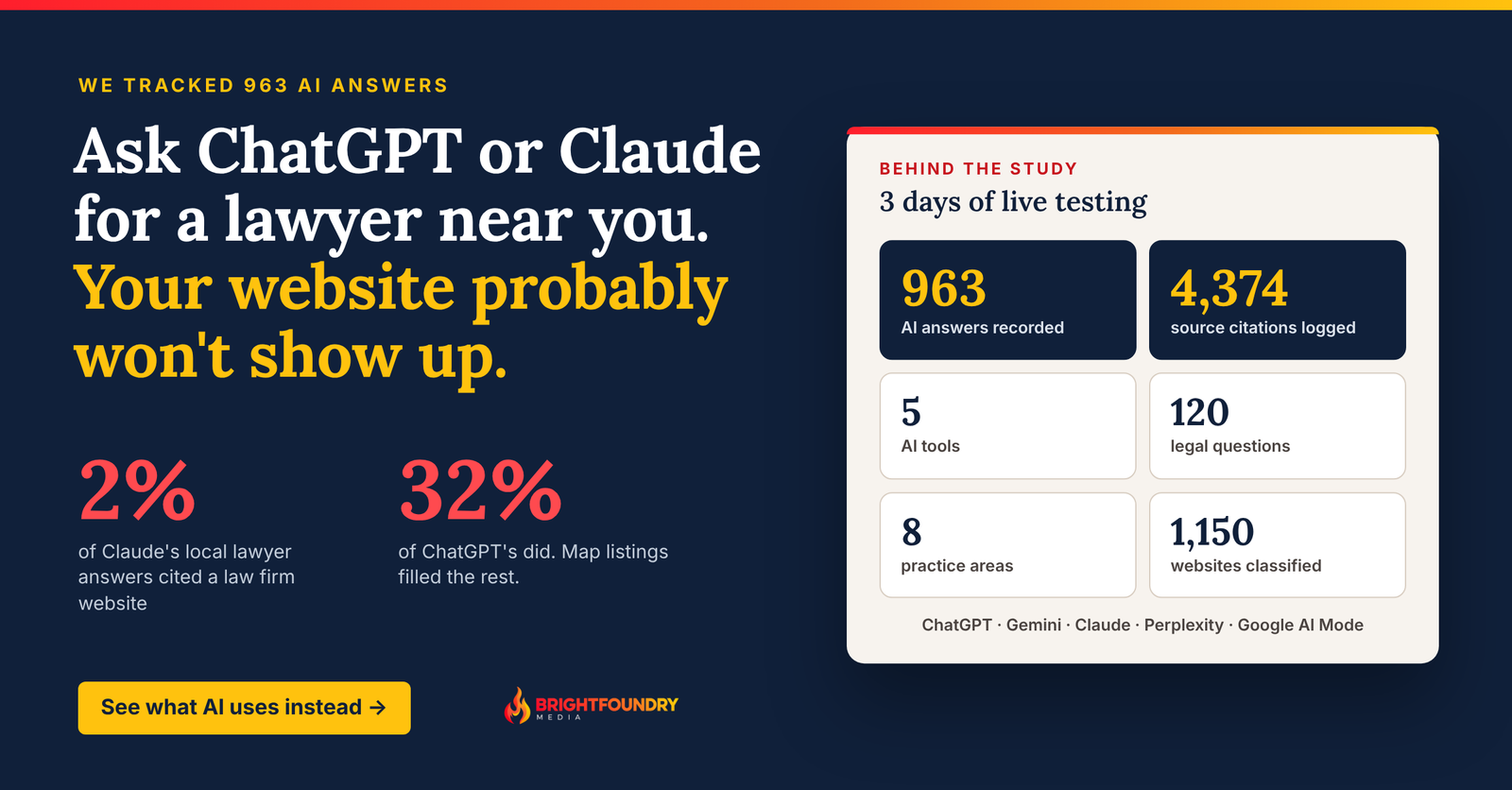
People now ask AI tools the same questions they used to type into Google: what happens after a DUI arrest, how alimony is calculated, who the best injury lawyer in Baltimore is. The answers they get name sources, and sometimes they name law firms. We wanted to know which websites those answers actually rely on, and whether it changes by platform, by practice area and by the kind of question being asked.
So we ran the questions ourselves. Over three days in November 2026 we asked ChatGPT, Google Gemini, Claude, Perplexity and Google AI Mode the same set of 120 Maryland legal questions, followed up the way a real person would, and recorded every source each answer cited: 963 answers in all. This post covers what we found.
The short version
- The type of question matters more than the platform. “Best lawyer” questions pull from lawyer directories. “Lawyer near me” questions pull from map listings. “How does this work” questions pull from government sites and law firm articles.
- Each AI tool has its own favorite sources. Gemini cited Justia in 60% of all its answers and Super Lawyers in 59%. ChatGPT leaned on Avvo and on map business listings. Google AI Mode relied on Google Business Profiles and law firm websites, and barely used directories.
- For local searches, two of the five tools skipped websites almost entirely. ChatGPT and Claude answered nearly every local question with map listings rather than links to firm websites.
- Government sites own the informational questions. ChatGPT cited a government or court website in 39 of 40 informational answers.
- Directory odds vary sharply by tool. Across all five tools, Justia appeared in 25% of hiring answers, Super Lawyers in 24% and Avvo in 18%. For Gemini alone, Justia and Super Lawyers each appeared in about three of four.
- Reddit almost never showed up. Out of 963 recorded answers, Reddit was cited seven times.
- Google AI Mode was the only tool that showed ads. Paid law firm listings appeared inside 16 of 23 informational answers, before anyone asked for a lawyer.
- When asked about free consultations, the AI tools went and checked. They read firm websites and directory profiles. Firms that state their consultation policy clearly got confirmed. Firms that do not were often left out or marked as unconfirmed.
How we ran the study
We wrote 120 prompts: 8 practice areas, 3 types of question, and 5 prompts for each combination. Everything was focused on Maryland so the answers could be compared.
| Question type | What it looks like | Prompts |
|---|---|---|
| Commercial | “Who is the best personal injury lawyer in Maryland?” | 40 |
| Local | “Divorce lawyer in Rockville” or “DUI lawyer near me” | 40 |
| Informational | “How is alimony calculated in Maryland?” | 40 |
The eight practice areas were personal injury, criminal defense, family law, estate planning, immigration, employment, workers’ compensation and business law.
Each informational question was followed by two more messages in the same conversation, the way a real person tends to continue: first “Can you recommend a good lawyer for this near me?” (or in a named Maryland city), and then “Which of those offer free consultations?” That gave us three answers per informational conversation and showed how the sources shift as someone moves from research to hiring.
We used each tool without personal history. ChatGPT ran in temporary chat with web search on, Gemini in temporary chat, Claude in incognito mode with web search, plus Perplexity and Google AI Mode in standard mode. We counted a source type as present when an answer cited at least one website of that type. Map and business listing cards were counted as their own type, since they are a source even when no website link appears.
Finding 1: “Best lawyer” questions run on directories
When someone asks for the best lawyer in a practice area, most AI tools reach for lawyer directories and ranking sites. The table shows the share of answers that cited at least one source of each type.
| Platform | Law firm sites | Directories | Map listings | Government |
|---|---|---|---|---|
| ChatGPT | 75% | 88% | 95% | 38% |
| Gemini | 90% | 100% | 0% | 2% |
| Claude | 66% | 84% | 34% | 3% |
| Perplexity | 88% | 80% | 0% | 2% |
| Google AI Mode | 100% | 20% | 85% | 20% |
The directories that appeared most often were Justia, Super Lawyers, Avvo, Best Lawyers, FindLaw, Cornell’s Legal Information Institute lawyer directory, Chambers and Lawyers.com. Gemini cited at least one directory in every single commercial answer. Google AI Mode was the clear exception: it named firms using their own websites and Google Business Profiles instead.
For a firm, this means a “best lawyer” answer is often built from what directories say about you. An incomplete or outdated directory profile is something an AI tool may repeat to a prospective client.
Finding 2: Local questions run on map listings, for most tools
Local questions, such as “family lawyer in Frederick” or “workers’ comp lawyer near me,” split the platforms into two camps.
| Platform | Law firm sites | Directories | Map listings | Avg. sources per answer |
|---|---|---|---|---|
| ChatGPT | 32% | 10% | 100% | 2.0 |
| Gemini | 98% | 98% | 0% | 5.6 |
| Claude | 2% | 2% | 98% | 1.1 |
| Perplexity | 80% | 60% | 0% | 3.5 |
| Google AI Mode | 100% | 18% | 68% | 7.6 |
ChatGPT and Claude answered local questions almost entirely from map listings. Claude showed a map with ratings and rarely linked to anything else. ChatGPT showed business listing cards, and cited a firm website in only about a third of its local answers. Gemini and Perplexity did the opposite: no map listings, and heavy use of firm websites and directories. Google AI Mode used both, pairing Google Business Profiles with links to firm websites.
The practical point is that there is no single local strategy anymore. A complete, accurate business listing with reviews is what two of these tools look at first. A strong website and directory presence is what the other two look at. Google’s own AI uses both.
Finding 3: Informational questions run on government sites
For questions about how the law works, the AI tools leaned heavily on official sources such as the Maryland Courts, the Maryland General Assembly, the Register of Wills, the MVA, the Department of Labor, USCIS and the Maryland People’s Law Library.
| Platform | Government & courts | Law firm sites | Legal publishers | Legal tech & other businesses |
|---|---|---|---|---|
| ChatGPT | 98% | 28% | 20% | 12% |
| Gemini | 62% | 82% | 18% | 35% |
| Claude | 52% | 68% | 32% | 55% |
| Perplexity | 80% | 65% | 20% | 18% |
| Google AI Mode* | 87% | 87% | 13% | 35% |
*Google AI Mode reached a request limit partway through the study, so its informational figures are based on 23 conversations rather than 40.
ChatGPT is the most conservative here. It cited a government or court source in 39 of its 40 informational answers and used law firm articles in fewer than a third. Gemini and Google AI Mode cited law firm articles in most informational answers, often alongside government sources, and those articles came from firms both inside and outside Maryland.
Claude stood out in a different way. More than half of its informational answers cited websites that are neither law firms nor government sources: online legal services, document and filing companies, fee calculators and software vendors. In practice, that means a Maryland law firm writing about the same topic was competing with businesses that publish legal explainers to sell a product.
This is the one question type where a firm’s own content regularly gets cited by name. The articles that showed up tended to answer one specific Maryland question directly, with the numbers, deadlines and steps a reader needs.
Finding 4: Every platform has its own favorite sources
Looking at all answers together, each tool showed a distinct pattern in which sites it trusted.
| Platform | Most-cited sources (share of all answers) |
|---|---|
| ChatGPT | Map business listings (62%), Avvo (25%), Maryland Courts (9%), Super Lawyers (9%), Maryland General Assembly (7%) |
| Gemini | Justia (60%), Super Lawyers (59%), Avvo (22%), Cornell LII directory (10%), Maryland People’s Law Library (9%), FindLaw (7%) |
| Claude | Map listings (45%), Avvo (16%), FindLaw (12%), Best Lawyers (8%), Cornell LII directory (5%), Lawyers.com (5%) |
| Perplexity | Justia (16%), Super Lawyers (10%), Best Lawyers (8%), Maryland People’s Law Library (6%), Maryland Courts (5%) |
| Google AI Mode | Google Business Profiles (71%), Maryland People’s Law Library (9%), YouTube (8%), then a long tail of individual law firm websites |
Perplexity spread its citations across the widest range of individual law firm websites, with no single directory dominating. Google AI Mode cited the most sources per answer, about eight on average, and most of them were firm websites.
The odds your directory profile gets used
Firms often ask which directory listings are worth paying for or keeping up. We cannot see which firms hold which listings, but we can measure how often each directory was used as a source when someone was looking for a lawyer. For this section we looked only at hiring answers: the “best lawyer” and local questions, plus the two follow-ups where people asked for a recommendation and about free consultations. That is 760 answers across the five tools.
Read each figure as the odds that a directory appears as a source in a hiring answer. A listing on that directory is what the AI tool reads when it does. A higher number means more chances for your profile to shape what the AI tells a prospective client, not a guarantee that your firm is the one named.
| Directory | All five tools | ChatGPT | Gemini | Claude | Perplexity | Google AI Mode |
|---|---|---|---|---|---|---|
| Justia | 25% (about 1 in 4) | 8% | 76% | 8% | 22% | 8% |
| Super Lawyers | 24% (about 1 in 4) | 14% | 74% | 6% | 16% | 2% |
| Avvo | 18% (about 1 in 6) | 31% | 27% | 20% | 6% | 2% |
| FindLaw | 7% | 4% | 9% | 15% | 4% | 1% |
| Best Lawyers | 7% | 6% | 7% | 9% | 11% | 1% |
| Cornell LII lawyer directory | 6% | 4% | 12% | 6% | 4% | 1% |
| Best Law Firms | 3% | 1% | 8% | 4% | 4% | 0% |
| Chambers | 3% | 6% | 2% | 3% | 1% | 3% |
| Lawyers.com | 3% | 2% | 6% | 6% | 1% | 0% |
| LawInfo | 2% | 0% | 8% | 1% | 2% | 0% |
| Martindale-Hubbell | 2% | 4% | 2% | 4% | 0% | 0% |
| Any of these directories | 52% | 50% | 97% | 39% | 46% | 17% |
Three things stand out. First, the right directory depends on the tool. A Justia or Super Lawyers profile was used in about three of every four Gemini hiring answers, but in fewer than one in ten from ChatGPT, Claude or Google AI Mode. Avvo was the directory ChatGPT and Claude leaned on most. Second, Gemini used at least one directory in 97% of its hiring answers, so for Gemini a directory profile is close to unavoidable. Third, Google AI Mode used directories in only 17% of hiring answers, because it relies on Google Business Profiles and firm websites instead.
Directory odds by practice area
The overall numbers hide real differences between practice areas. The first table shows how often each directory was used in hiring answers for each practice area, across all five tools.
| Practice area | Justia | Super Lawyers | Avvo | FindLaw | Best Lawyers | Chambers | Any directory |
|---|---|---|---|---|---|---|---|
| Personal injury | 20% | 20% | 14% | 9% | 4% | 0% | 46% |
| Criminal defense | 23% | 22% | 29% | 14% | 6% | 3% | 58% |
| Family law | 25% | 22% | 21% | 10% | 5% | 0% | 49% |
| Estate planning | 25% | 25% | 19% | 4% | 8% | 1% | 49% |
| Immigration | 31% | 18% | 14% | 3% | 9% | 3% | 48% |
| Employment | 20% | 29% | 23% | 2% | 8% | 9% | 54% |
| Workers’ compensation | 39% | 29% | 13% | 6% | 6% | 0% | 56% |
| Business law | 18% | 24% | 9% | 6% | 10% | 10% | 53% |
The second table shows, for each practice area, the single directory each tool used most often in its hiring answers and how often it appeared.
| Practice area | ChatGPT | Gemini | Claude | Perplexity | Google AI Mode |
|---|---|---|---|---|---|
| Personal injury | Avvo 25% | Justia 75% | FindLaw 20% | Super Lawyers 30% | Justia 10% |
| Criminal defense | Avvo 55% | Justia 70% | FindLaw 35% | Justia 30% | Avvo 6% |
| Family law | Avvo 25% | Justia 90% | Avvo 35% | Justia 20% | Justia 5% |
| Estate planning | Avvo 40% | Super Lawyers 95% | Avvo 20% | Justia 25% | Justia 5% |
| Immigration | Avvo 25% | Justia 80% | Best Lawyers 15% | Justia 20% | Justia 20% |
| Employment | Avvo 40% | Super Lawyers 85% | Avvo 30% | Justia 15% | Super Lawyers 10% |
| Workers’ compensation | Super Lawyers 30% | Justia 80% | Justia 25% | Justia 50% | Justia 20% |
| Business law | Avvo 16% | Super Lawyers 75% | Avvo 11% | Best Lawyers 20% | Chambers 30% |
A few patterns are worth calling out. Avvo was ChatGPT’s go-to directory in seven of the eight practice areas, and it showed up in more than half of ChatGPT’s criminal defense hiring answers. Gemini relied on Justia or Super Lawyers in every practice area, at rates between 70% and 95%. Workers’ compensation was the practice area where Justia mattered most across tools. Business law was the one area where Chambers, a ranking aimed at larger firms, became the top directory for Google AI Mode.
Each practice area and tool combination is based on 10 to 20 answers, so treat these as directional. Where a tool’s sample in an area was 10 answers, a single citation moves the figure by 10 points.
What the recommended firms have in common
Directories are one part of the picture. We also looked at the firms themselves to see what separates a firm that several AI tools recommend from a firm that shows up once. This part of the study is smaller and should be read as a first look, not a final answer.
Website authority and backlinks. We compared the 32 firms whose websites were cited most often by three or more of the five tools with 29 firms whose websites were cited only once, using third-party estimates from Ubersuggest.
| Measure (median) | Firms cited by 3 or more tools | Firms cited once |
|---|---|---|
| Domain authority | 26.5 | 18 |
| Referring domains | 614 | 238 |
| Total backlinks | 8,161 | 1,357 |
| Share with domain authority under 15 | 3% (1 of 32) | 48% (14 of 29) |
The firms that several AI tools agreed on had, at the median, more than twice as many websites linking to them. Nearly half of the one-time mentions had very weak link profiles, compared with one of the consensus firms. This does not prove that links cause AI recommendations. Firms with strong link profiles also tend to be older, larger and better reviewed. But it fits how these tools work, since most of them search the web and lean on sources that are already well established.
Reviews. Claude was the only tool that showed star ratings and review counts for every firm in its map results, so we used its 279 unique firm listings to look at reviews.
- 95% of the firms Claude recommended had a Google rating of 4.5 or higher, and 80% had 4.8 or higher. Only a handful were below 4.5.
- Review volume mattered much less than rating. The median firm had 68 reviews, but 15% had fewer than 20, and a few had one to three reviews.
- Review counts tracked the practice area. The median was 150 reviews for personal injury, 126 for criminal defense, 106 for workers’ compensation and 91 for immigration, compared with 59 for family law, 45 for employment, 37 for business law and 33 for estate planning.
In practice, a strong rating appears to be close to a requirement for Claude’s map recommendations, while a modest number of reviews does not rule a firm out.
Distance. We were not able to measure each firm’s distance from the center of each city reliably, so we did not score it. What we can say is that location was decided by where each tool thought the person was, not by the city center. When a question named a city, most recommendations were in that city or the next town over. When the question said “near me,” the results followed each tool’s guess about the user’s location, which differed by more than 20 miles between tools in our test.
Finding 5: Reddit barely registers for legal questions
A lot has been written about AI tools citing Reddit. In our legal sample, it hardly happened. Out of 963 recorded answers, Reddit appeared seven times: three in Gemini and four in Google AI Mode. ChatGPT, Claude and Perplexity did not cite it at all. Video and social platforms were almost entirely a Google AI Mode habit: it cited YouTube in 11 answers, plus a few Instagram and Facebook posts, while Gemini cited YouTube once and the other three tools never did. For Maryland legal questions, these tools stuck to government sites, directories and law firm websites.
Finding 6: Asking for a recommendation changes the sources
The first follow-up, “Can you recommend a good lawyer for this?”, turned an informational conversation into a hiring conversation, and the sources changed with it.
- ChatGPT switched to map business listings in every conversation, often adding a directory or two.
- Claude switched to its map view in all but one conversation, showing ratings and locations with no website links. The exception was an asylum question, where it recommended only nonprofit legal service organizations.
- Gemini cited directories and law firm websites in all 40 conversations, usually Justia and Super Lawyers plus the firms’ own sites.
- Perplexity usually asked where the person was located when the follow-up said “near me,” and drew on firm websites and directories once it knew the city.
- Google AI Mode used Google Business Profiles alongside firm websites in every conversation we recorded.
“Near me” also meant different places to different tools. From the same computer in Gaithersburg, Gemini and Google AI Mode used the device location and recommended Gaithersburg and Rockville firms. ChatGPT and Claude placed us in Ellicott City and Columbia based on our internet connection, more than 20 miles away, and recommended firms there. A firm can show up for one tool and not another simply because each tool decided the searcher was somewhere else.
Finding 7: AI tools check free consultation claims
The second follow-up, “Which of those offer free consultations?”, produced the most useful finding for firms. ChatGPT, Claude and Gemini did not guess. They went back out, read the firms’ websites and directory profiles, and reported which firms they could confirm. ChatGPT often added a note when it could only find the claim on a third-party listing rather than the firm’s own site. Claude frequently relied on directory profiles, and in several answers it said the firms’ own websites did not state a policy at all.
How many recommended firms the tools could confirm depended heavily on the practice area.
| Practice area | What the AI tools typically found |
|---|---|
| Personal injury | Nearly all recommended firms confirmed |
| Criminal defense | Most or all confirmed |
| Workers’ compensation | Nearly all confirmed |
| Estate planning | About half to three quarters confirmed |
| Family law | Often only one firm, or none, confirmed |
| Immigration | Usually one firm or none confirmed; Claude could not confirm a free consultation for most firms in four of five conversations |
| Employment | Low; Gemini separated a free intake call from a paid consultation, and Claude often confirmed none |
| Business law | Usually two firms or fewer confirmed |
Some of this reflects real pricing. Many family, immigration and business firms charge for consultations. But several answers said plainly that a firm’s policy could not be found online, which is a different problem. If a firm does offer a free or low-cost first meeting and it is not stated clearly on the website and directory profiles, the AI tool has nothing to confirm, and the firm drops out of the answer.
Finding 8: Google AI Mode puts ads inside the answer
Google AI Mode was the only tool that showed paid placements. A sponsored block of law firm ads appeared in 16 of 23 informational answers, 16 of 40 commercial answers and 15 of 40 local answers we recorded. In other words, a person reading an AI Mode answer about how probate or alimony works was often shown paid lawyer listings before they had asked for a lawyer at all. None of the other four tools showed ads in our testing.
What this means for law firms
None of this replaces the fundamentals, but it does show where AI tools are looking. Based on what we saw:
- Treat directory profiles as part of your website. Justia, Super Lawyers, Avvo, FindLaw and Best Lawyers fed a large share of “best lawyer” answers. Make sure each profile is complete, current and consistent with your site.
- Keep your business listings complete and accurate. Two of the five tools answered local questions almost entirely from map listings. Your name, address, phone, hours, categories and reviews are what those answers show.
- State your consultation policy plainly. Put it on your practice area pages and your contact page, and make it match your directory profiles. Whether it is free, flat-fee or credited toward a retainer, say so.
- Write content that answers one Maryland question well. The firm articles that were cited answered a specific question directly, with the details a reader needs. Government sites are the competition here, so accuracy and specificity matter.
- Treat links and reviews as AI visibility work. The firms several tools agreed on had more than twice the referring domains of one-time mentions, and nearly every firm in Claude’s map results was rated 4.5 or higher.
- Check each platform yourself. Every tool in this study recommended different firms for the same question. Ask each one about your practice area and city and see what it says, and where it got that information.
Limits of this study
AI answers change from one run to the next, and these tools update often. We ran each prompt once per platform, so treat the percentages as a snapshot of patterns, not fixed rates. All prompts were about Maryland, and results in other states may differ. Google AI Mode reached a request limit during our informational prompts, so its informational results cover 23 conversations, and none in employment, workers’ compensation or business law. One ChatGPT business law conversation is missing its final free consultation answer because a draft message tool inside the answer blocked the follow-up. We counted sources at the website level and did not judge whether each answer was legally accurate. Backlink and authority figures are third-party estimates from Ubersuggest, and the review figures come only from Claude’s map results, so both are directional. We did not rank or evaluate any law firm named in the answers, and this post does not name them.
If you would like to see how your firm shows up across these tools, BrightFoundry can run the same kind of check for your practice areas and cities.